





















Warehouses are among the most dangerous work environments in the United States, and the data makes that difficult to dispute. The Bureau of Labor Statistics reports a warehouse injury rate of 4.8 cases per 100 full-time workers, more than double the 2.3 all-industry average. Forklifts alone account for approximately 85 fatalities and 34,900 serious injuries annually in American workplaces, according to OSHA. For business owners in logistics, distribution, and light manufacturing, these numbers translate directly into workers’ compensation costs, experience modification ratings, and insurance premiums.
Warehouse safety and workers’ compensation are not separate conversations. Every injury claim affects your experience modification rate (EMR), which in turn affects what you pay for coverage, often for three years after the loss. Here are seven things every warehouse business owner needs to understand about how safety and workers’ comp intersect.
1. Your EMR Is a Three-Year Running Average — Not a Snapshot
The experience modification rate is calculated using three years of loss data, with the most recent year excluded. A single significant claim can elevate your EMR for three consecutive renewal cycles. An EMR above 1.0 signals higher-than-average risk to carriers and results in premium surcharges. An EMR below 1.0 generates credits. Warehouse operations with consistent injury exposure often accept elevated EMRs as a cost of business when they should be treating EMR improvement as a multiyear financial project.
2. Forklifts Are Your Highest Severity Exposure
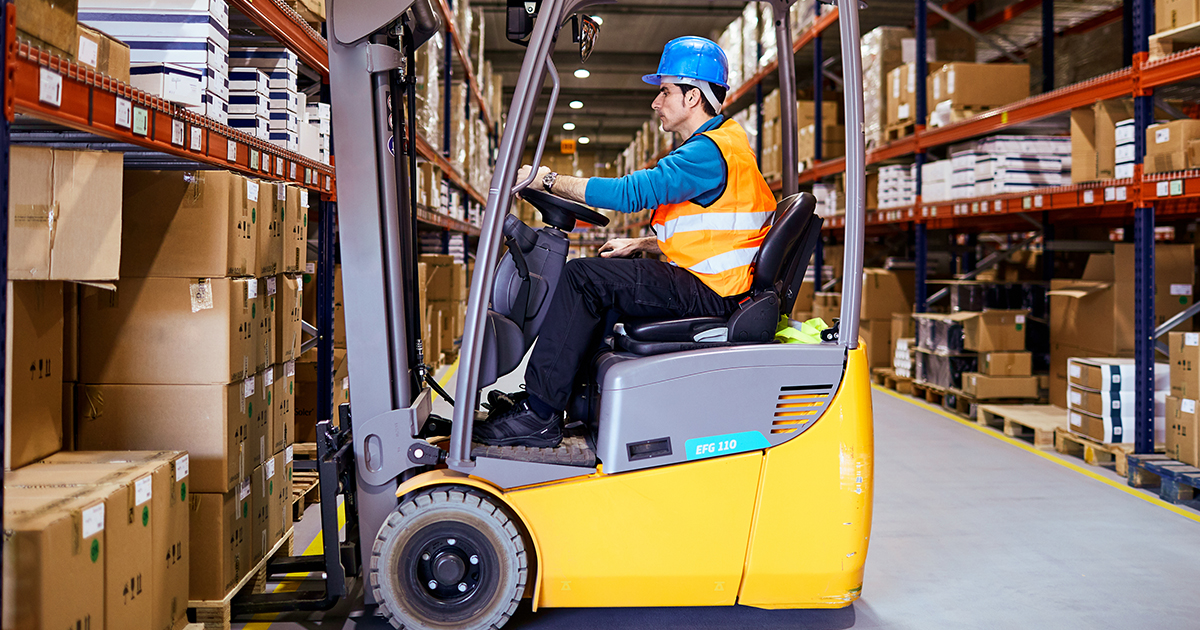
Forklift tip-overs account for 42% of forklift fatalities. Pedestrians struck by powered industrial trucks represent the single largest category of forklift work fatalities, according to BLS data cited in an OSHA directive. A single forklift injury generates direct workers’ compensation costs of $38,000 to $41,000 on average before accounting for indirect costs including lost productivity, supervisory time, training replacement workers, and OSHA penalties. Powered industrial truck violations ranked sixth among all OSHA citations in fiscal year 2024, with over 2,200 citations issued. The underwriting scrutiny on forklift operations has increased in parallel.
3. Overexertion and Repetitive Motion Claims Accumulate Quietly
Forklifts generate the most severe individual claims. Overexertion, from lifting, pushing, pulling, and carrying, generates the most claims by frequency. These injuries rarely produce dramatic incidents. They accumulate across the workforce over months and years, and they are among the most expensive categories to manage on a per-claim basis because they frequently involve soft tissue damage with long recovery timelines. E-commerce fulfillment centers, which operate at higher throughput rates than traditional warehousing, experience injury rates nearly double those of non-fulfillment facilities.
4. Slips, Trips, and Falls Are Preventable at Scale
Slips, trips, and falls account for 27% of all non-fatal warehouse injuries, according to the Bureau of Labor Statistics. Falls from ladders and elevated platforms represent 20% of fatal warehouse accidents. These are also the category of injuries most responsive to environmental controls, including floor marking, maintenance schedules, footwear standards, and lighting quality, all of which can measurably reduce incident rates. Carriers evaluate housekeeping and environmental controls during loss control visits, and their findings directly influence renewal terms.
5. Return-to-Work Programs Reduce Claims Cost More Than Any Other Single Intervention
The cost of a workers’ compensation claim is not fixed at the time of injury. It is determined largely by how long the injured worker remains off the job. Medical costs escalate significantly when recovery is extended, and indemnity payments, or wage replacement during disability, compound with duration. A structured return-to-work program that brings injured employees back to modified duty during recovery can reduce total claim costs substantially, typically by 30% to 50%, and reduce EMR impact proportionally. Carriers view the presence of a formal return-to-work program as a significant positive underwriting factor.
6. OSHA Violations Create Compounding Financial Exposure
Serious OSHA violations carry penalties of up to $16,550 per violation in 2025. Willful violations, meaning those where the employer knew of a hazard and did not correct it, carry penalties of up to $165,514 per violation, with each day of non-compliance potentially treated as a separate violation. Beyond the direct penalty, an OSHA citation is discoverable in litigation and can be used by plaintiffs’ attorneys to establish negligence. Businesses that receive OSHA citations without correcting underlying conditions are building evidence against themselves.
7. Loss Control Services Are an Underwriting Differentiator, Not a Compliance Exercise
The commercial insurance team at Tooher-Ferraris works with warehouse and logistics operations to structure workers’ compensation programs that reflect actual safety investment, build toward EMR improvement, and align loss control engagement with renewal strategy. Learn more at https://toofer.com/commercial-insurance/ and https://toofer.com/dynamic-risk-synergy-portal/.
OSHA’s powered industrial trucks standard (29 CFR 1910.178) provides the regulatory baseline for forklift operations, and the National Safety Council’s Injury Facts data at injuryfacts.nsc.org provides current fatality and injury statistics across industry categories.
Frequently Asked Questions
What is an experience modification rate (EMR) and how does it affect workers’ comp premiums?
The EMR is a multiplier applied to your workers’ compensation base rate that reflects your claims history relative to businesses of similar size and type. An EMR of 1.0 means you pay the standard rate. An EMR below 1.0 generates a premium credit; above 1.0 generates a surcharge. The calculation uses three years of loss data and can affect premiums for multiple renewal cycles after a significant claim.
What are the leading causes of warehouse workers’ compensation claims?
The four leading categories are forklift-related injuries (highest severity), overexertion from manual material handling (highest frequency), slips, trips, and falls, and struck-by incidents involving powered equipment or falling objects. Forklift tip-overs and pedestrian-forklift collisions account for the majority of fatal incidents.
How do return-to-work programs reduce workers’ compensation costs?
Return-to-work programs bring injured employees back to modified duty during recovery, which reduces indemnity payments, shortens claim duration, and limits the medical cost escalation associated with extended disability. Formal programs also signal to carriers that the business manages claims proactively, which influences EMR trajectory and renewal pricing.
Ready to build a workers’ compensation program that reflects your safety investment? The team at Tooher-Ferraris has been helping businesses manage workers’ comp costs since 1932. Contact us today to schedule a no-obligation consultation — https://toofer.com/contact-us/